
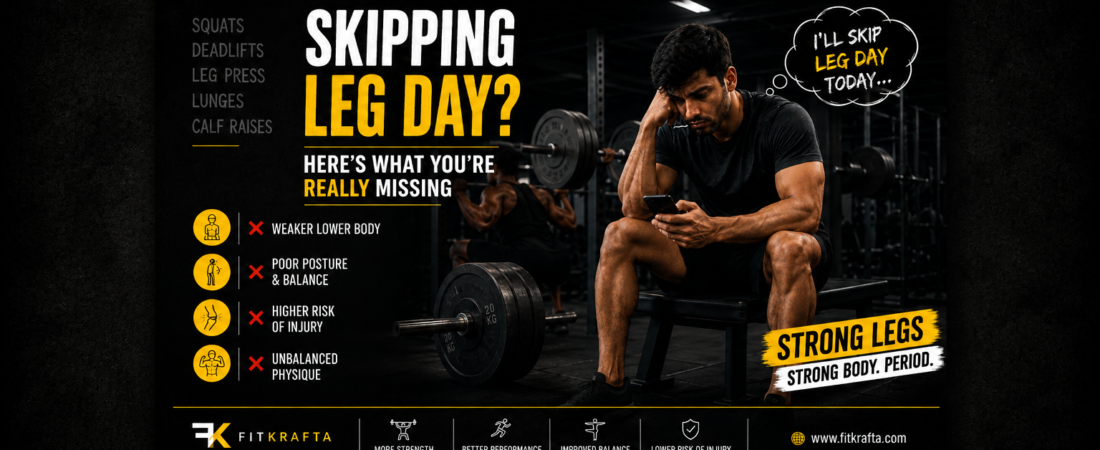
The gym, everyone wants a bigger chest, broader shoulders, and bigger arms. But when leg day arrives, suddenly people start skipping leg day and finding excuses to avoid it. “I’ll do it tomorrow.” Sounds familiar, right?
Missing leg day once in a while is not a big deal. But if you regularly avoid training your legs, you may be missing out on much more than just bigger legs.
Strong legs are not only about having a better-looking physique. Lower-body training can support your strength, stability, balance, posture, and physical performance.
So, why is leg day actually so important? Let’s find out.
Leg Training Supports Overall Strength
Exercises like squats, lunges, and deadlifts do much more than simply train your legs.
These compound movements involve multiple muscle groups, including your hips and core, while also challenging your body to stay stable. This makes leg training useful for developing strength and coordination across your body.
Regular resistance training is well known for improving strength and physical function. So, the goal of leg day is not just to build bigger thighs—you are building a stronger lower body that can support your overall physical strength.
How Skipping Leg Day Can Affect Your Overall Strength
Your core is not just about having visible abs. It plays an important role in keeping your body stable and helping you control your movements.
During exercises like squats and deadlifts, your core has to work to keep your torso stable while you move the weight. This means your abdominal and lower-back muscles can also be involved during heavy compound leg exercises.
However, this does not mean leg day alone will automatically give you a strong core. Properly performed compound leg exercises can support core strength and stability as part of a complete training routine.
Skipping Leg Day Can Affect Your Core Strength
Posture is not only about your back. Your hips, legs, and core also play a role in your body’s stability, movement, and control.
When your lower body is strong, it can help you maintain better control during different movements and exercises. But there is one important thing to understand: leg day will not magically “fix” your posture.
Posture can also be influenced by mobility, muscle strength, movement habits, and individual factors. A better way to put it is that lower-body and core strength can actively support healthy posture and better body control.
How Skipping Leg Day May Affect Your Metabolism
Your legs contain some of the largest muscle groups in your body.
Resistance training helps build and maintain muscle mass, and lean muscle contributes to your body’s daily energy needs. Research also suggests that resistance exercise can increase your resting metabolic rate.
However, this does not mean one leg workout will permanently make your metabolism “fast.” Long-term results depend on your overall training, nutrition, and recovery. Leg day is not a magic metabolism hack, but it is an important part of a regular resistance-training routine.Strong Legs Can Improve Your Physical Performance
Skipping Leg Day Can Limit Your Physical Performance
Think about running, climbing stairs, jumping, or playing a sport. Your lower body plays an important role in all of these activities.
Stronger legs can help you produce force, control your body, and perform movements more efficiently. That is why lower-body strength is not only useful inside the gym; it can also help with everyday activities and physical performance outside the gym.
Does Skipping Leg Day Affect Testosterone and Muscle Growth?
This is a very common belief in the gym. Heavy resistance exercise can temporarily increase testosterone after a workout.
But that does not mean the testosterone spike from leg day will automatically make the muscles throughout your body grow faster. Muscle growth depends on several critical factors, including:
Progressive resistance training
Adequate protein and sufficient calories
Quality sleep and recovery
Instead of thinking of leg day as a “testosterone hack,” think of it as an essential piece of your overall strength and muscle-building routine.
What Should You Do If You Hate Leg Day?
If you do not enjoy leg day, you still don’t have to completely ignore your lower body. You can keep your workout simple and manageable—for instance, following a structured Push-Pull-Legs split can help balance the workload so it doesn’t feel overwhelming.
A basic leg session could include:
- Squats or Leg Press
- Romanian Deadlifts
- Lunges or Split Squats
- Calf Raises
Your exercise selection can change depending on your experience, goals, mobility, and available equipment.
The most important thing is consistency and progressive overload. You do not need to perform endless exercises every workout. Instead, focus on gradually improving your strength, reps, or training quality over time.
Final Takeaway
Leg day is not just about building bigger legs. Regular lower-body training can support your strength, stability, balance, physical performance, and muscle development.
Missing one workout is not a big deal. But if you keep skipping leg day every week, you are leaving an important part of your training behind. A complete physique is not built with just a chest and biceps. A strong body needs strong legs too.
So, the next time leg day comes around and your mind says, “I’ll skip it today…”
Remember: Leg day is not just for your legs. It is part of building a stronger body.